


“Mom – I’m the world No. 1.
That was the headline screaming off the front page of Spain’s leading sports daily Marca on Monday, March 15, 1999 — quoting a 22-year-old, long-haired kid from Mallorca, Carlos Moyá, moments after his semifinal win over Gustavo Kuerten in the locker room at Indian Wells.
For the first time ever, Spanish tennis had a world No. 1. And for the man at the center of this story, success wasn’t just coming — it was accelerating.
The tennis boom from the Iberian Peninsula had been building for years. Back-to-back Roland Garros titles in ’93 and ’94 — Spain’s first since 1972 and Andrés Gimeno — led by Sergi Bruguera, another familiar name on the Umag stage, signaled the shift. What followed was a full decade of rising names and major results.They were laying the foundations for the “chosen ones” to come — future heirs who would outlive entire tennis eras, names we’ll only reach later on this journey through time.
“Tennis doesn’t owe you anything. You either win or you don’t,” Moyá would say years later. Few careers prove that point more clearly. In less than 26 months, he went from relative unknown to Australian Open finalist (’97), French Open champion (’98), and world No. 1. “Moyamania” had already swept across Spain, and Carlos — now a figure of mainstream culture — was reaching full-on rock star status.
And as always, some of the most important pieces of this story are tucked away in the Umag archive — which is exactly where our Time Machine takes us next.
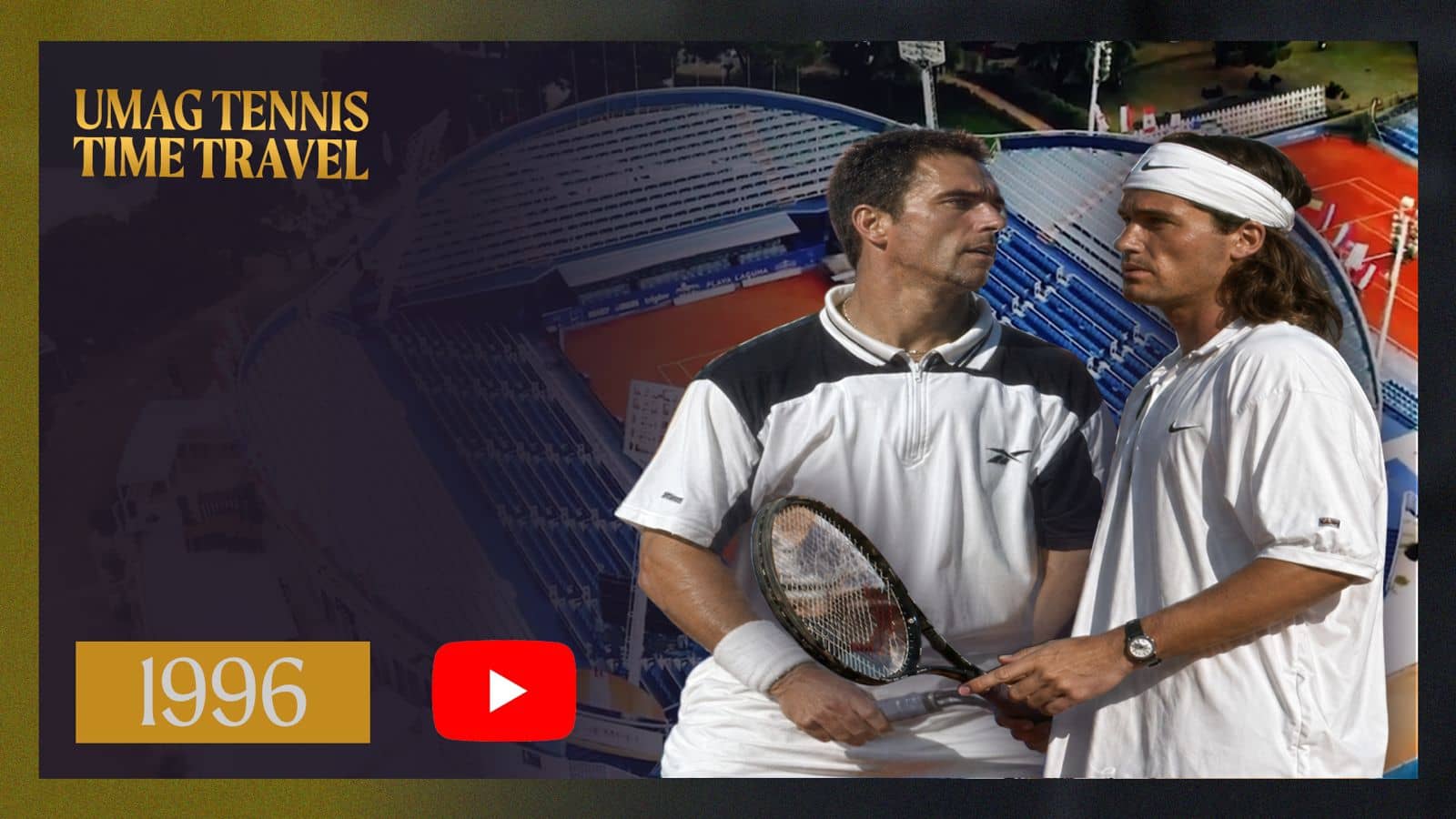
1996 Tournament – the Spanish Armada and the young guns rising
From its inaugural edition in 1990, the tournament had steadily grown in stature, establishing itself as a respected proving ground — especially for Spanish and other clay-court specialists. In that context, the 1996 edition brought together a remarkably strong field, led by players who arrived in Umag with one clear objective — to go all the way.
Among them was Albert Costa, the top seed and future Roland Garros champion (2002), who would go on to reach No. 6 in the world.
Charging through his section of the draw was the lively, curly-haired Brazilian Gustavo Kuerten — a future superstar, three-time French Open champion and world No. 1 — until he was stopped in the quarterfinals by Norway’s Christian Ruud. Though he never reached the heights of his contemporaries, Ruud belongs to a rich tennis lineage — the father and later coach of today’s star, Casper Ruud.
Worth noting, Ruud Sr. returned to Umag in ’99, where he was beaten in three sets by another gifted young player, Ivan Ljubičić, who had made his tournament debut back in 1996. Years later, Ljubičić would say that playing in Umag was the dream of every Croatian player. That summer, he was stopped in the second round by Kuerten.
A pillar of Croatian tennis, Ljubičić would go on to play under the Umag sky 12 times — never forgetting how, in those early years, a wild card would regularly find its way into his mailbox. Yet he never went all the way — the title remained out of reach, at times without the favor of fortune.
The tournament also remembered its first champion — a wild card was extended to Goran Prpić, who was bidding farewell in 1996.
And finally — the two finalists. Both at the beginning of their rise, each with a single title to their name. Carlos Moyá, coming off his Buenos Aires ’95 triumph, where he had defeated the very man who would stand across the net that windy Sunday — Félix Mantilla, the 1996 Porto champion, who had blown Moyá off the court in the semifinals (6–0, 6–4).
FINAL – MOYÁ’S CLINIC
The stage was set for the final on Sunday, August 18 — the last time in the tournament’s history that the title match would be played in the second half of August.
On court, however, the drama never arrived — what the crowd witnessed instead was Moyá driving straight down a “one-way street.”
The more gifted player, Carlos Moyá, was simply better on the day. His attacking, high-risk tennis proved far too much for his opponent. Throughout the match, he unleashed his signature weapon — the forehand — striking winners from every angle and position with breathtaking ease.
The opening set was wrapped up in just 22 minutes, and the same script threatened to continue. An inspired Moyá rattled off nine consecutive games, racing to a 6–0, 3–0 lead, before Félix Mantilla, after finally getting on the board, raised his racket to the crowd with a smile — a touch of self-irony, a brief intermezzo in a match slipping steadily out of his hands.
Moyá did momentarily lose rhythm later in the set, allowing the match to drift into a tie-break, but he never let go of control.
By a score of 6–0, 7–6, Carlos Moyá claimed his first title in Umag — and in doing so, wrote the opening chapter of one of the most iconic and enduring stories in the sport: the story of the “King” of Umag.
MANTILLA – Moyá in the way & the win greater than one over Federer
Perhaps unfairly — as is often the case in sports narratives where, in the end, only the clear line between winner and loser remains — Félix Mantilla is too often overlooked, living in the shadow of a name that so often stood in his way.
Mantilla, the 1997 Umag champion, would get his revenge a year later by knocking out Carlos Moyá in the semifinals. On his way to that lone Umag title, he also defeated Andrei Cherkasov, Dominik Hrbatý — remembered by Croatian fans from that iconic 2005 — and in the final, his fellow Spaniard, the great Sergi Bruguera.
Still, even though he occasionally found a way past his countryman (head-to-head 9–5 in Moyá’s favor), his most painful losses came against him — at the very edge of greatness: the 1997 Australian Open quarterfinal, and the following year’s Roland Garros semifinal.
When the line is drawn under a remarkably successful career, the numbers remain: 10 ATP titles, a place among the world’s top ten — and one unforgettable week in Rome, where he seemed to step straight out of Gladiator by Ridley Scott.
Instead of Russell Crowe, it was a bearded Mantilla ruling the Foro Italico, channeling that same gladiatorial force. In May 2003, not even Roger Federer could stop him — Federer who, just a month later, would win his first Wimbledon and begin an era of unprecedented dominance.
“It started as a joke with my fitness coach — I told him I wouldn’t shave until my next loss. But the truth is, in Rome I always thought of Gladiator. I felt good with the beard — so much so that people in the crowd would shout that I looked like Russell Crowe,” Mantilla recalled.
And yet, his greatest victory didn’t come on a tennis court. In 2006, he was diagnosed with melanoma and defeated the disease. Today, through his foundation, he works to raise awareness, especially among professional and amateur athletes, about the risks of skin cancer and the seriousness of the illness.
MOYÁ – THE LEGEND BEGINS
For the winner of that final, who had made his Umag debut a year earlier only to exit in the first round, the wheels of destiny were already in motion.
Umag — a launchpad that would, in the years to come, send remarkable careers into orbit and build a legacy of its own — seemed to follow a script already written, one that began with the man who would become the tournament’s defining figure.
In this chronicle of our journey through Umag’s past, Carlos Moyá — later known as “Charlie” — is a name we will return to again and again. Here, we stay with what came immediately after the summer of 1996.
At the 1997 Australian Open, the first Grand Slam of the season, Moyá arrived as a relatively unknown player. Riding a wave of inspired tennis, he surged all the way to the final — where he ran into an immovable obstacle in Pete Sampras.
During the trophy ceremony, the defeated Carlos Moyá delivered the iconic line “hasta luego, Lucas” (loosely translated as “see you later”), a reference to a phrase coined by the legendary Spanish comedian Chiquito de la Calzada. The reaction from the Spanish crowd was immediate — and, as Moyá would admit decades later, people still greet him with those same words.
(Chiquito de la Calzada was an immensely popular Spanish comedian whose unique, invented language significantly influenced everyday speech, making him one of the earliest “influencers” of popular culture. His “Chiquitistani” style relied on wordplay, invented expressions and phonetic distortions, creating a distinctive and humorous mode of communication.)
Moyá’s popularity exploded from that point on, and his tennis career continued its meteoric rise. The following year, he captured his only Grand Slam title at Roland Garros, and in 1999, upon becoming world No. 1, he admitted that only one goal remained — the Davis Cup.
“This is the most important achievement of my career. There have only been 15 or 17 world No. 1s in history, while 200 to 300 players have won Grand Slam titles,” (author’s note: 153 individual Grand Slam champions to date) Moyá said — almost prophetically, as the next great peak of his career, marked by injuries, would indeed come with the 2004 Davis Cup triumph.
And in that moment, Moyá became the 15th man in history to reach world No. 1 — in a season defined by fierce competition and a clash of generations, where five different players held the top ranking: Pete Sampras, Carlos Moyá, Yevgeny Kafelnikov, Andre Agassi, and Patrick Rafter — still a record for a single season.
.jpg)
.png)
.png)