


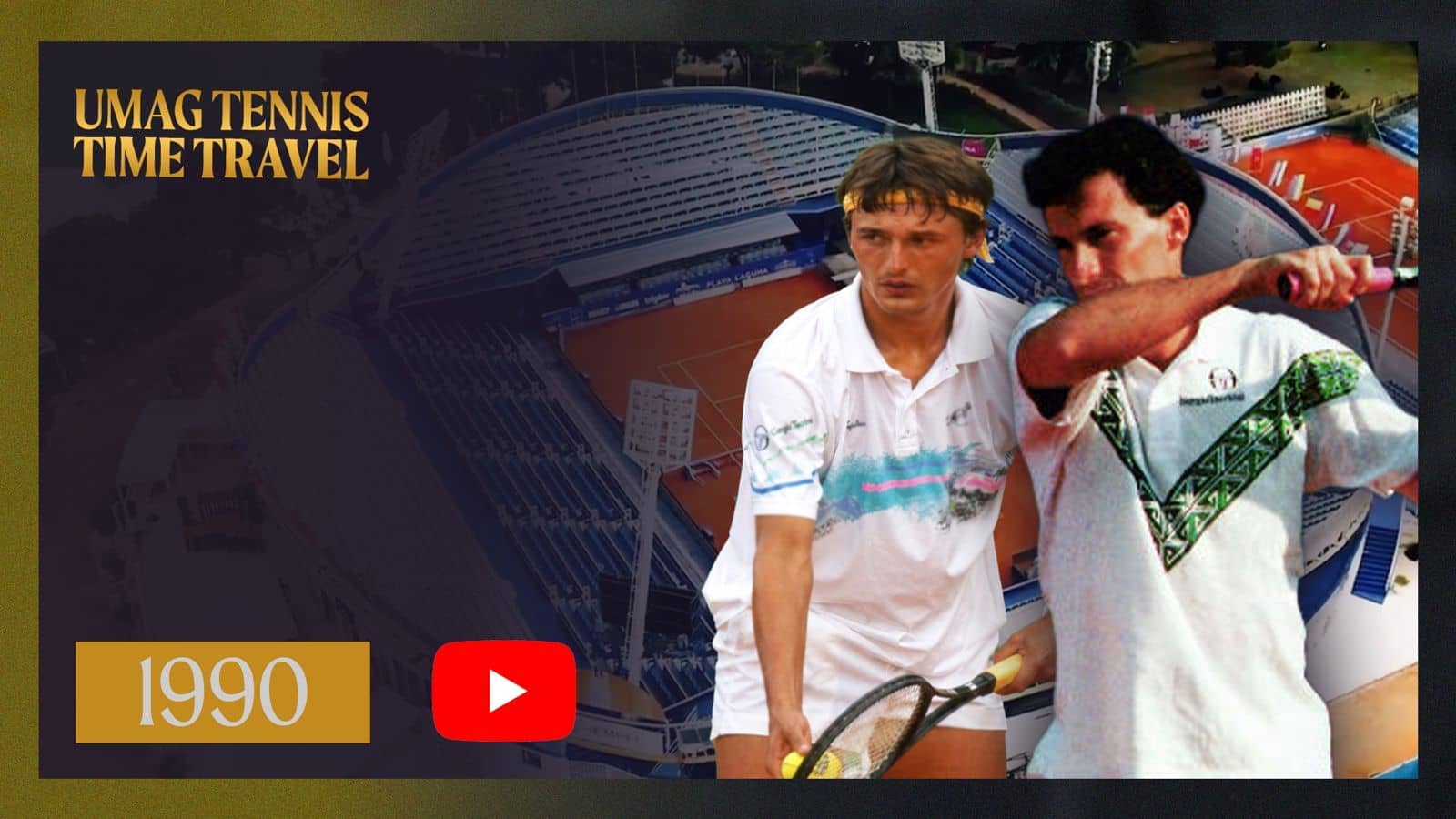
The inaugural edition of the Umag tournament, then known as the Yugoslav Open, was held from 14 to 20 May 1990 and brought together a diverse and colourful field. The draw was led by the top two seeds — our two Gorans, Ivanisevic and Prpic — already friends and Davis Cup teammates at the time.
Among those to note was Andrei Cherkasov of the then Soviet Union, who arrived in Umag on a wildcard. The Russian from Ufa reached the quarterfinals of both the Australian Open and the US Open in 1990, and his path would later intertwine again with the main protagonists of this story — as we will revisit later.
Umag’s clay also attracted the usual strong South American presence, but a few other names stood out. Among them was Germany’s Eric Jelen, a member of the famed Davis Cup generation led in the late 1980s by the great Niki Pilic. Germany won back-to-back titles in 1988 and 1989, with key doubles victories delivered by Jelen alongside the legendary Boris Becker. Notably, Jelen would later coach Becker in two brief spells following the end of his playing career.
And finally, a certain Marián Vajda appeared in Umag in 1990, a Slovak player with a solid career and two clay-court titles to his name prior to his arrival in Istria. He would, however, achieve global recognition much later — as the long-time coach and a key member of the team of the greatest tennis player in history, Novak Djokovic.
A TOURNAMENT OF FATE DRIVEN BY BOLD VISION
Fate — it is hard to escape that impression — had already begun to play its part long before the first ball was struck in May ’90, setting the course for what was to follow.
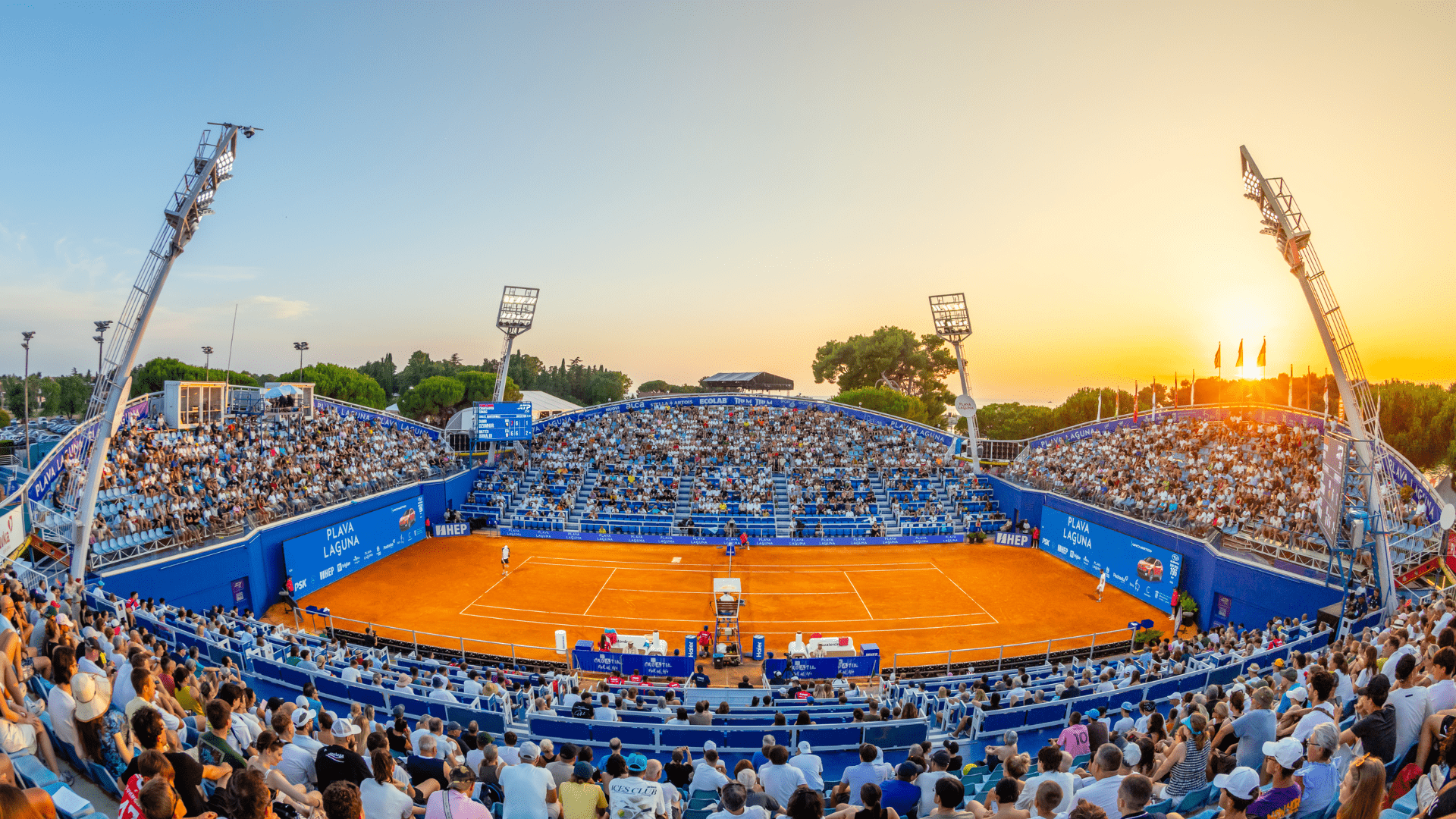
By the late 1980s, Umag was thriving with tennis courts, and the culture of the game was growing through a series of recreational competitions, most notably the “Istrian Riviera.” Rising interest gave shape to a clear vision: a stadium and a tournament would emerge on ground where, as locals would later recall, there had once been potato fields and a stretch of swamp.
And then, once again, that same unstoppable sense of fate — in 1990, the ATP took over the governance of men’s professional tennis, with the existing Grand Prix events under the ITF transitioning into the newly formed ATP Tour.
From New York, at a major ATP summit, the Umag delegation returned with extraordinary news: out of 26 applications, the Tour’s expansion had been confirmed in just four cities — the metropolises of Beijing and Moscow, Portugal’s Estoril, a tourist hub known for its Formula One races, and a small tennis “powerhouse” in the making — Umag.
WHEN TWO CROATIANS MET IN THE FINAL – THE ONLY TIME
And so, on the tournament’s final Sunday, two of our Gorans stepped onto the court — referred to hereafter by their surnames for clarity.
Prpic reached the final having dropped just one set, back in the opening round against Belgium’s Eduardo Masso. Ivanisevic, meanwhile, moved convincingly through his half of the draw until the semifinals, where he dropped a set to Andrei Cherkasov. Everything was thus set for their second meeting of the season, after Ivanišević had prevailed in three sets earlier in Brussels.
With one set apiece, the match was decided in the third. The younger Ivanisevic showcased his blend of explosive shot-making and movement, while Prpic countered with touch, variation in rhythm, and tactical composure.
In the end, it was Prpić’s patience and match intelligence that proved decisive. With both players holding serve to 4–4 in the final set, Prpić seized his moment with a break and closed it out in the very next service game, sealing the match 6–3, 4–6, 6–4.
After more than an hour and a half of play, Goran Prpic became the first-ever champion of the Umag tournament. To this day, the 1990 match remains the only all-Croatian final in its history.
PRPIC — THE ONLY TITLE, BUT A SPECIAL ONE
“I already thanked him back then, at the trophy ceremony, for ‘letting me have’ that tournament, because I knew he would go on to win plenty of titles by the end of his career. And I was right,” Goran Prpic once said in an interview for Vecernji list, only half joking. The 1990 title would remain the only one of his career, alongside two runner-up finishes in clay-court finals.
A man whose career — and especially his contribution to Croatian tennis — has aged remarkably well, he remains a true gentleman to this day: interesting, somewhat reserved, and without any need to fill newspaper columns with controversy.
That image of “Prpa” is captured even in the legend that he drove a Fiat 126 in the 1980s “because it could be started without a key,” a story he himself confirmed. He did not, however, drive away from Umag with the trophy in the popular “Maluch” (author’s note: it was a Mercedes 190E).
The symbolism of winning the first “Umag,” a memorable playing career that saw him rise as high as world No. 16, as well as a successful coaching career in which he at one point simultaneously led both the men’s and women’s national teams, ultimately fall into the background compared to what would unfold in the summer of 1992 in Barcelona.
IVANISEVIC THEN AND NOW — ONE OF A KIND
The defeated version of Ivanisevic on that day closely resembled what would follow him throughout his great career. As a heavy burden, he carried his frustrating inconsistency, a familiar surge of chaos and emotion. The popular “Zec” (author’s note: literally rabbit in translation, a nickname inherited from his father) would take off and put back on his yellow headband, send his racquet flying in unpredictable arcs, and allow himself the full range of unfiltered verbal outbursts — in short, he was himself. Completely his own — flawed, brilliant, and unforgettable.
Yet his talent was undeniable to every eye watching — it leapt off the screen, raw and untamed. From the very beginning, he was the kind of player who could drive you crazy, only to pull you back in the very next moment — because, against all logic, you couldn’t help but fall in love with him.
A young man who, at 17, had already reached the quarterfinals of the Australian Open, and at 18, just two months after Umag, claimed his first ATP title in Stuttgart, signalling great things to come.
It already drove, back then in Umag, long before their relationship — more than that of a man behind the microphone and a player on the court — would become deeply personal and emotional, Mico Dusanovic, the legend of tennis commentary, into professional frustration. Although impeccably impartial throughout the final, he could not escape the impression of Ivanišević’s constant battle against his most difficult opponent — himself.
The rest is that somewhat better-known history, which we will revisit elsewhere.
Goran — allow the author of this text the freedom to call him, at least once, by the name we all know him by best — appeared on Umag clay only once, in 1990, a fact few in the tennis community have ever truly gotten over. Despite that, the bond between Goran and Umag remains unbreakable: since 2016, the central court bears his name — ATP Stadium Goran Ivanisevic — and he, charismatic and globally admired, remains present as the tournament’s main ambassador.
A SYMBOLIC BEGINNING AS A GLIMPSE OF WHAT WAS TO COME
Few could have imagined, back in 1990, that just two years later — in the midst of the breakup of the former Yugoslavia — tennis would deliver the first two Olympic medals to the newest member of the Olympic family, the independent Republic of Croatia. Later that same August, the old name was set aside, and the first Umag tournament under the name “Croatia Open” was played.
The first of those two bronze medals came from the familiar duo of friends and rivals from that inaugural Umag final, while Ivanisevic added a second in singles. Another bronze, also in singles, went to our old acquaintance Cherkasov, competing under the flag of the CIS (Commonwealth of Independent States), defeating both Prpic and Pete Sampras along the way.
The symbolism of those moments is unmistakable: the Umag tournament began on emotionally true foundations — with a final between two players who would go on to write the opening chapters of Croatia’s greatest sporting achievements, at a time when international recognition was of vital importance. In doing so, they wove tennis deeply into the sporting identity of the young nation, while laying the foundations of the Umag tournament and establishing it as a bearer of the Croatian tennis story.
Croatian tennis would continue to deliver remarkable results for decades, and the ATP Plava Laguna Croatia Open tournament in Umag not only endured as the country’s sole event of its kind, but grew year after year in stature and organisation — leaving behind a lasting sporting and cultural legacy that endures to this day.

.jpg)
.png)
.png)